
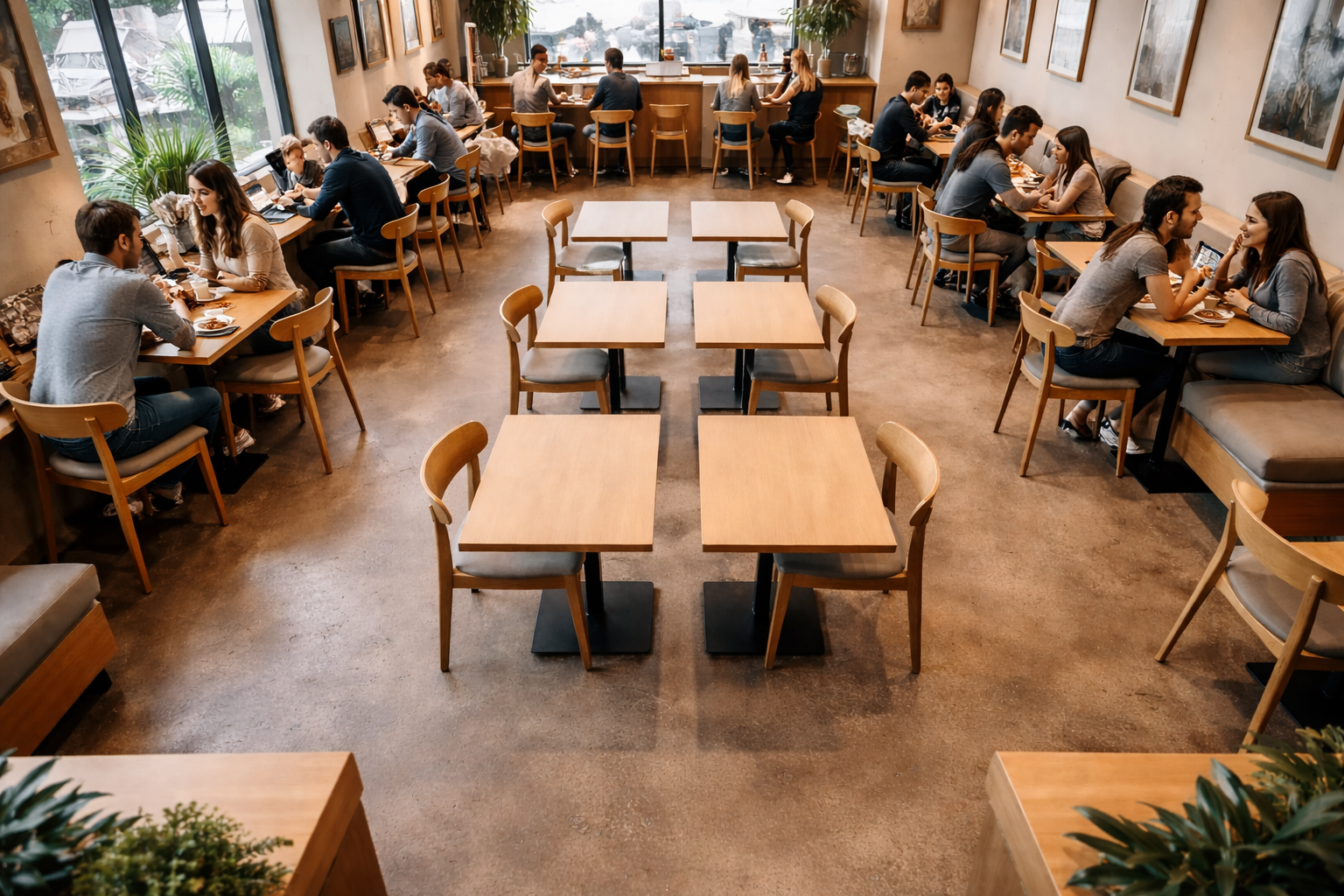
At first glance, this cafe layout looks completely logical. Maximum seating capacity, great natural light, beautiful matching furniture. But watch how people actually use the space.
During the morning rush, every table along the walls is claimed. Laptops, coffee cups, settled bodies. Meanwhile, the perfectly good tables floating in the center of the room sit completely empty. Customers are choosing to turn around and leave rather than sit in the middle. The owner thinks it is a slow day. It is not a slow day. It is a spatial design problem hiding in plain sight.
This pattern shows up in almost every cafe, coworking space, and hotel lobby I walk into. I call it the Fishbowl. The geometry is different in each room, but the result is always the same: occupied perimeter, abandoned center, and an owner who blames foot traffic for what is actually a spatial design problem.
What the Room Is Saying
The owner arranged these chairs with the best of intentions, aiming for efficiency and energy. But the geometry is sending a signal the owner never intended. The center tables offer total exposure from 360 degrees. Sitting there means having your screen, your face, and your unprotected back exposed to the front door, the coffee queue, and the gaze of everyone on the perimeter. The room is broadcasting one thing to every solo customer who scans for a seat: you will be watched from every direction, and you will have no control over it.
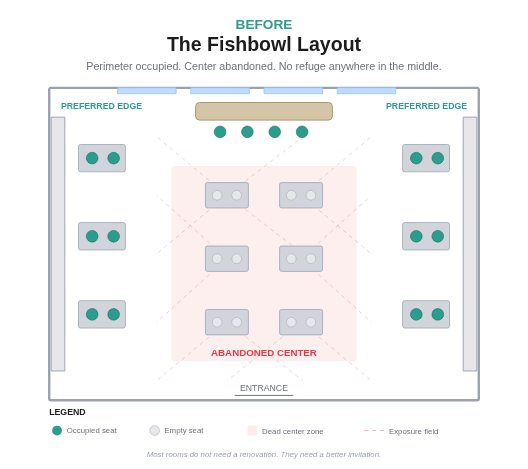
The Fishbowl layout. Perimeter occupied, center abandoned.
The OED Read
This is a Regulation failure. Two foundational rules are broken at once.
The Orientation Rule: no center seat has a protected back. Every chair floats in the open with exposure on all sides.
The Sightline Rule: the sitter cannot command a clear view of the entrance because the exposure comes from everywhere simultaneously. There is no direction that feels safe to face.
Prospect-refuge theory explains why this matters at a biological level. Humans carry an ancient, non-negotiable need to see without being seen. We seek a protected back (refuge) and a clear view of the room (prospect). The perimeter walls provide both naturally. The center provides neither. This is not a preference. It is wiring.
When a customer stands at the register and scans the room, their nervous system runs a rapid environmental appraisal in under two seconds. Lisa Feldman Barrett’s predictive processing framework describes what happens next: the brain is constantly budgeting energy based on environmental predictions, and a seat that offers no refuge forces the nervous system to spend metabolic resources on vigilance instead of relaxation. The body registers the ambiguous exposure as a low-grade threat. The customer’s decision is already made before they are conscious of making it. They turn around and leave.
The Optionality lever breaks as a consequence. The room forces a binary choice: endure the full exposure of the center, or retreat to the perimeter. There is no gradient. No seat that offers partial shelter with partial openness. Once the perimeter fills, the room is effectively full, even though a third of its seating capacity sits empty.
The Fix
You do not need new furniture. You need to break the sightlines. Take two tall, leafy potted plants and place them between the center tables. Or rotate the middle tables 45 degrees off the rigid grid. Either move creates a visual buffer that interrupts the crossfire of direct eye contact and gives the nervous system a small, vital slice of refuge.
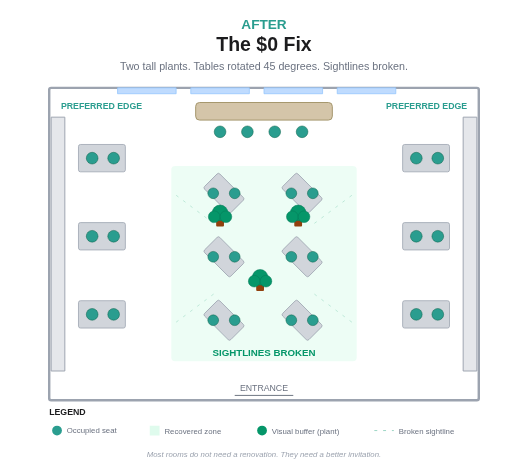
The $0 fix. Two tall plants, tables rotated 45 degrees, sightlines broken.
The directional principle: this space needs even a minor interruption in the exposure field to convert dead capacity into usable seating. That is the hint. The full systematic assessment of where to place every buffer, which angles to rotate, and how to build a true gradient from exposure to retreat is what a complete OED consultation delivers.
The Business Implication
Those empty center tables are not a slow morning. They are stranded capacity with a zero-dollar fix. If four two-tops sit unused during a two-hour peak window, that is eight seats generating zero revenue while customers walk out the door. Fix the sightlines, and the nervous system settles. Lower cortisol leads to longer dwell time. Longer dwell time leads to a second coffee, a pastry, a laptop session that stretches into lunch. For a cafe running tight margins, converting dead center seats into occupied ones may be the highest-leverage move available, and it costs less than a single bag of coffee beans.
A solo remote worker walks in, sees the full perimeter claimed, but instead of turning around, slides into a center table behind a broad leafy fern. Two hours later, they order a second latte and text a friend the address.
Most rooms do not need a renovation. They need a better invitation.
Your room is already telling people whether to stay or go. Most owners never hear it.
For $97, I’ll tell you exactly what it’s saying, why, and what to move to change the message. You get a full written diagnosis within a week. No renovation, no new furniture, no guesswork. Order now.