
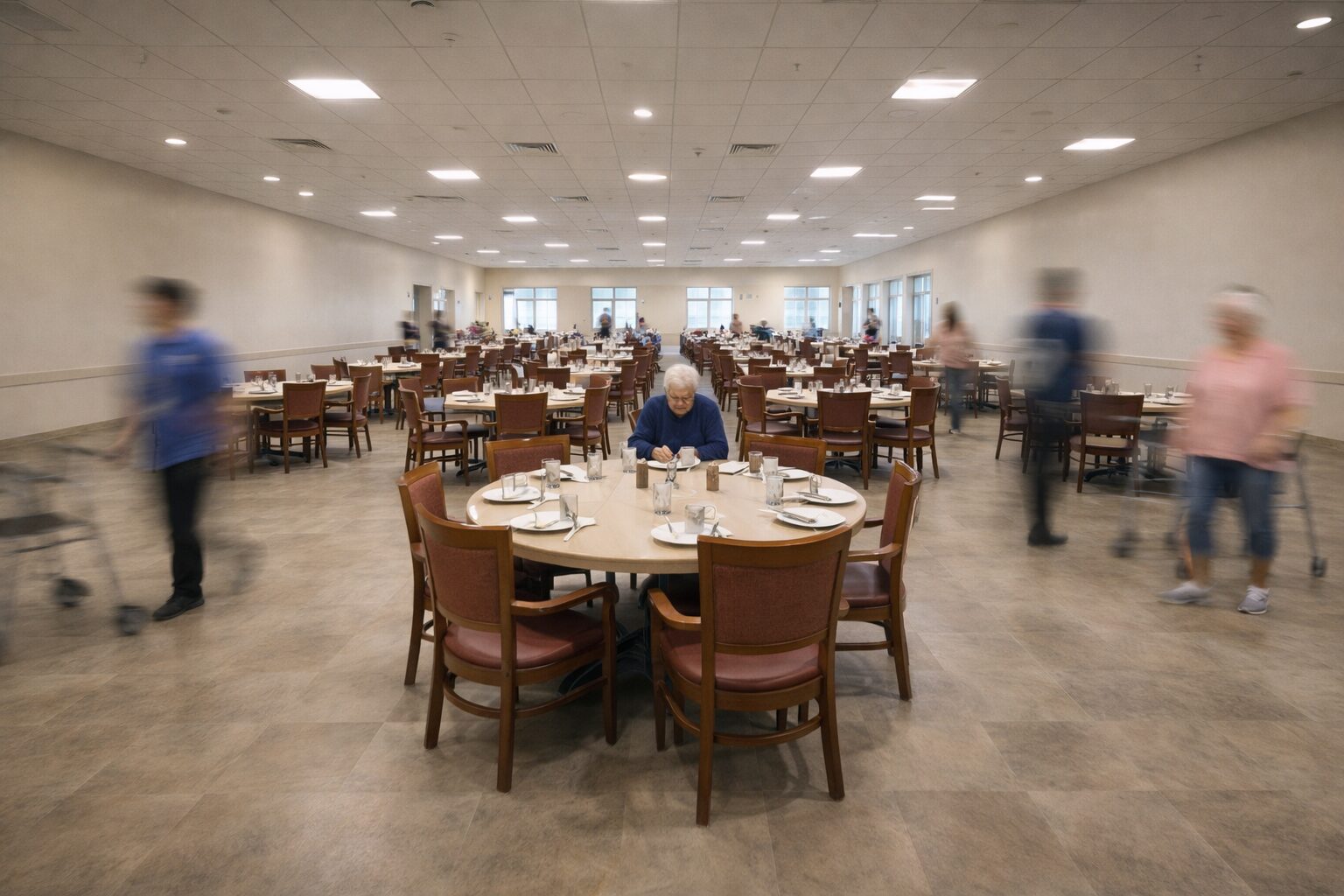
Nobody sets out to design a dining hall that sends residents back into isolation. This one was built to feel generous: beautiful natural light, expensive flooring, and large circular tables meant to signal energy, warmth, and community. The intentions behind it are good. But the real test is not how the room photographs. It is what happens to a nervous system the moment a resident walks in. Watch who stays for dessert. Watch who quietly stops coming down at all.
But watch who actually stays for dessert.
Watch who starts asking for meals in their room.
At the level of appearance, the room succeeds. At the level of use, it quietly fails.
What the Room Is Currently Saying
The room is asking residents to eat in the middle of a busy intersection.
Large tables float unanchored in the center of the floor. There are no safe edges. No quiet corners. No smaller places to participate without fully joining the crowd. The room offers total exposure or complete retreat, but no gradient in between.
I call it the Banquet Sea because nothing is anchored. The tables float in open exposure, traffic moves on all sides, and the resident is asked to dine offshore, without refuge.
That geometry becomes socially expensive very quickly.
Before a resident has taken a bite, the room is already demanding a high level of energy just to sit down.
The OED Read
This is a failure of Optionality. More specifically, it is a major prospect-refuge violation.
Prospect-refuge theory tells us that human nervous systems want to see without being overexposed. We settle more easily when our backs feel protected and our environment feels legible. In this dining hall, the resident is asked to eat in full exposure, with motion, noise, and bodies moving behind their back from every direction.
For a resident experiencing cognitive decline, hearing challenges, frailty, or simple sensory fatigue, this is not a minor inconvenience. It is an autonomic tax.
Lisa Feldman Barrett’s predictive processing framework helps explain why. The brain is constantly budgeting energy based on what it expects the environment to require. In a room that signals uncertainty, exposure, and interrupted control, the brain spends metabolic resources on vigilance instead of digestion, conversation, and ease.
That cost shows up in behavior.
Because the room offers only center-floor exposure, the real choice becomes binary. The resident must either tolerate the overwhelm or retreat and eat alone in their room.
When operators interpret that retreat as preference, they miss what the room is actually saying.
The resident is not necessarily rejecting community. The resident may be rejecting the geometry.
The Fix
Most rooms do not need a renovation. They need a better invitation.
Take two of the large center tables and move them to storage. Replace them with a series of small square two-tops anchored directly against the perimeter walls.
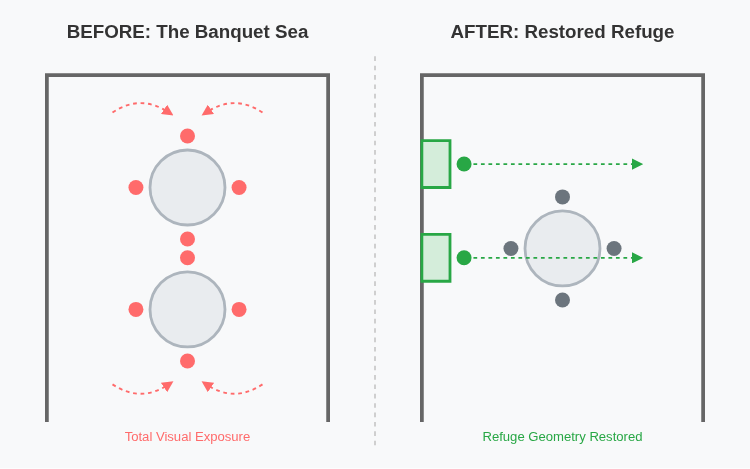
Now the room has a gradient.
Now a resident can join the life of the dining hall without bearing the full sensory load of its center. They can sit with a protected back, observe the room safely, and participate at a level their nervous system can actually afford.
This is not anti-social design. It is pro-optionality.
A good communal room does not force everyone into the same level of exposure. It gives people a range. Some residents will still choose the middle. Others will finally have a seat that lets them stay.
That is the point.
The Business Implication
Lower autonomic load has operational consequences.
When the dining hall feels safer, residents stay longer. Meal attendance rises. Fewer meals need to be individually plated and delivered to private rooms. Staff spend less time managing avoidable retreat behavior. Operational friction drops.
The health implications matter too. Better digestion, longer dwell time, more passive social contact, and more frequent visual exposure to communal life all push in the right direction.
And families notice.
A dining room full of residents quietly tolerating the center reads very differently from a dining room that offers visible choice. One feels managed. The other feels humane.
The Scene
A resident who has been eating alone in their room for three weeks chooses a perimeter two-top.
They sit with a solid surface behind them. They finish their entire meal. Halfway through dessert, they make a casual comment to the person at the next table about the soup.
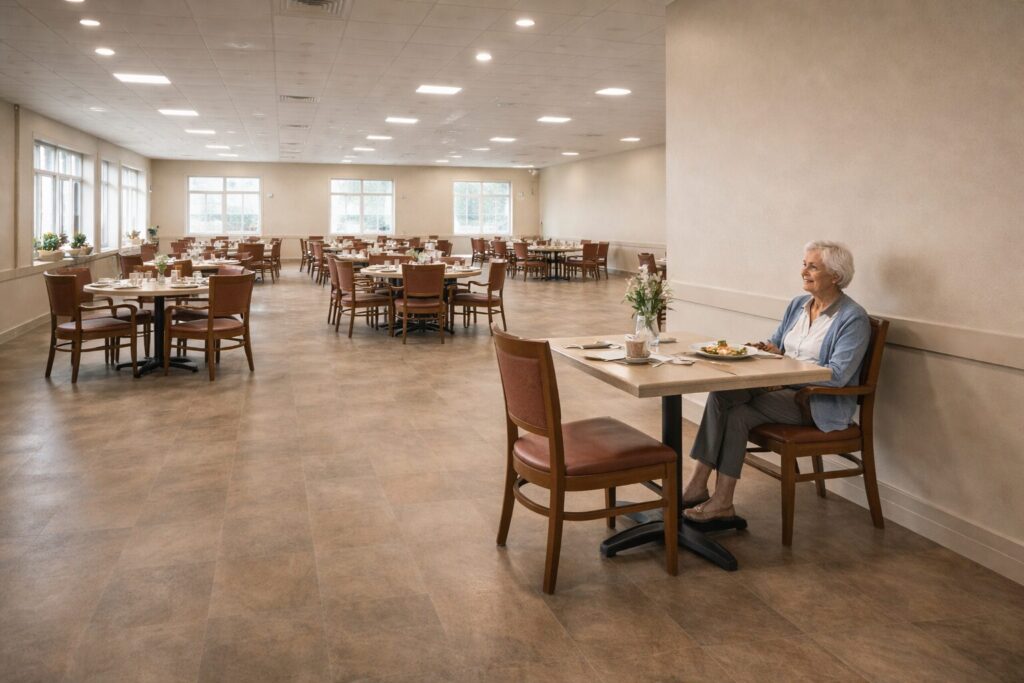
Ten minutes later, they are still there.
Not because staff persuaded them. Not because the programming improved. Because their nervous system finally felt safe enough to stay.
Most rooms do not need a renovation. They need a better invitation.
Your room is already telling people whether to stay or go. Most owners never hear it.
For $97, I’ll tell you exactly what it’s saying, why, and what to move to change the message. You get a full written diagnosis within a week. No renovation, no new furniture, no guesswork. Order now.