
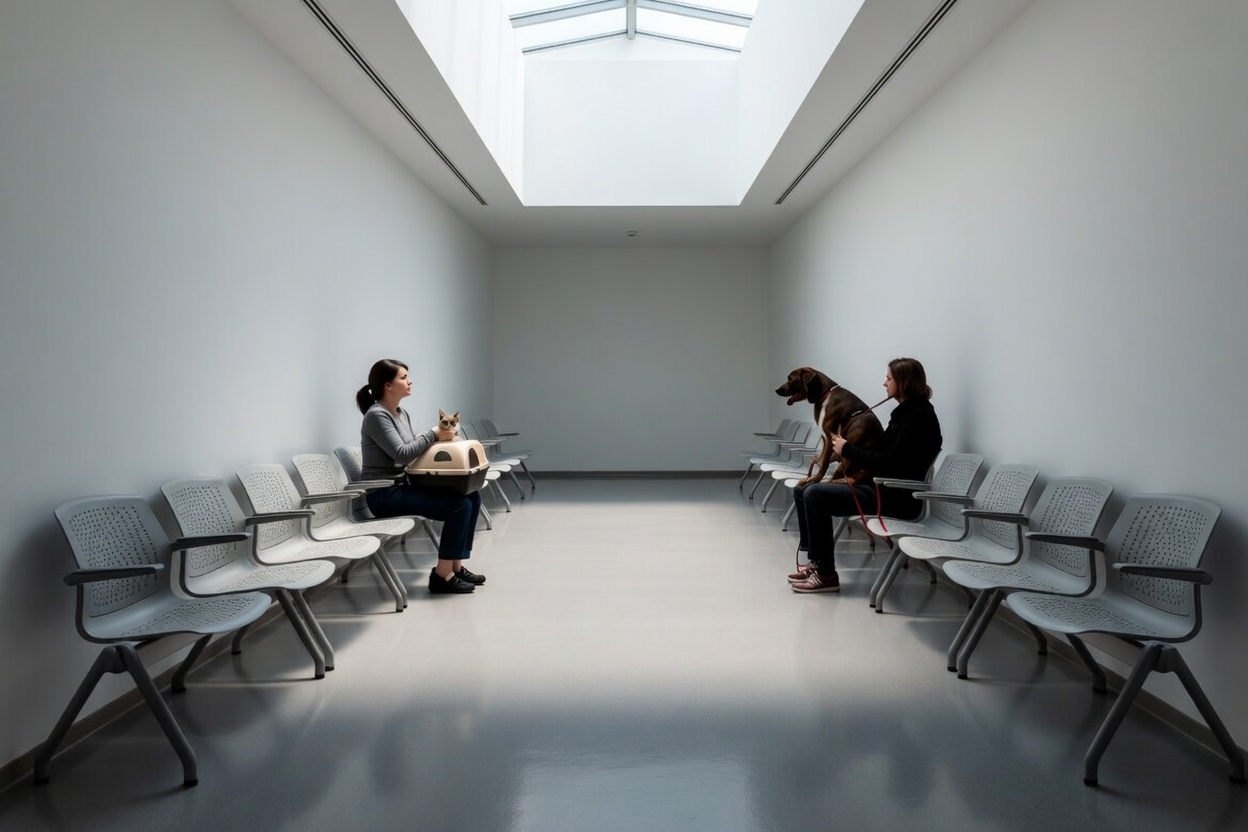
This modern veterinary lobby looks like a win. Expensive wipeable seating. Great natural light. Clear sightlines to the front desk. The intentions behind it are good.
But watch how people and their pets actually use the space.
Owners hover awkwardly by the door. Some clutch cat carriers tightly to their chests. Others turn around and wait outside in the parking lot. The chairs are physically available, but sitting in them is socially and biologically expensive.
What the Room Is Currently Saying
The seating is pushed flush against the perimeter walls. Every chair faces the dead center of the room. The result is confrontational geometry.
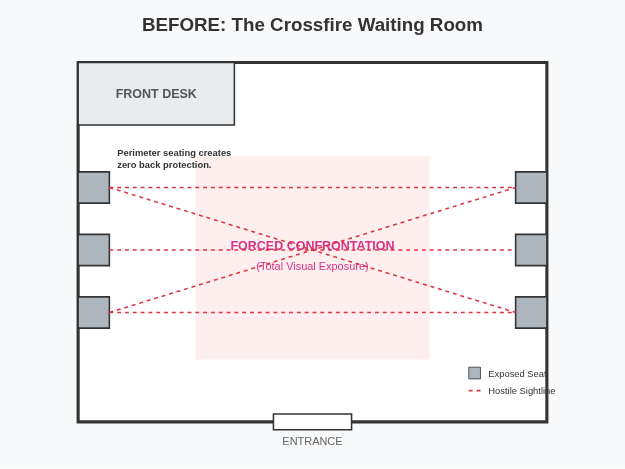
I call this pattern the Crossfire Waiting Room because every sitter is pulled into the same exposed field of observation. Dogs, cats, strangers, and stressed owners are all locked into unbroken lines of sight.
The room offers total exposure or complete retreat. There is no gradient in between. No perch. No visual shield. No place to hover before committing. The room is signaling high alert.
The OED Read
This is a failure of Regulation and Optionality at the same time.
Prospect-refuge theory tells us that mammalian nervous systems settle best in environments where they can see without feeling overexposed. A protected back and a manageable field of view lower anxiety. Violations spike it.
That is exactly what this room gets wrong.
A terrified rescue dog and an anxious cat in a carrier are forced into direct visual contact. Their owners feel it immediately. The front desk staff absorb it for eight hours a day. The room taxes three nervous systems at once.
Lisa Feldman Barrett’s predictive processing framework helps explain why. The body is constantly budgeting energy based on what the environment seems to require. When the room signals threat, visibility, and interrupted control, that budget gets spent on vigilance instead of calm waiting.
The autonomic cost of simply sitting down becomes too high. So people do what nervous systems do when a room fails them.
They leave.
The Fix
This space needs a gradient between exposure and refuge.
The fix costs almost nothing.
Pull the seating away from the perimeter walls. Rebuild it as back-to-back clusters in the center of the room. Anchor those new seating islands with a tall retail display or a sturdy artificial plant. That one move creates a visual buffer, breaks the hostile sightlines, and gives the sitter a protected back.
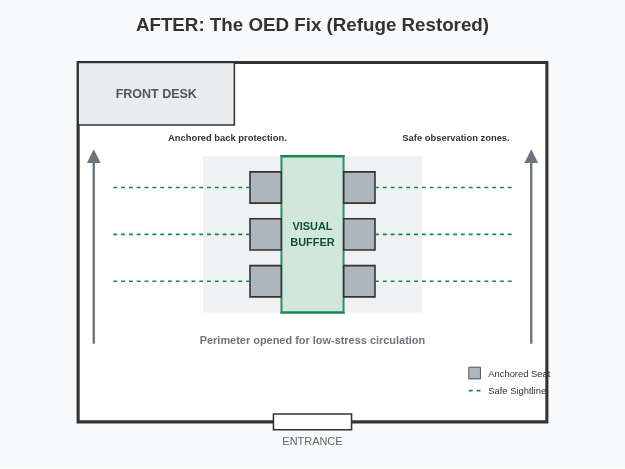
Now the room has options.
Now a client with a reactive dog can settle without feeling watched from every angle. Now the owner of a frightened cat does not have to choose between the crossfire and the parking lot.
The Business Implication
A stressed nervous system is less compliant. It is also more price-sensitive.
When an animal is frantic because of a prospect-refuge violation, the owner goes into survival mode. They cannot hear the receptionist explain the premium dental package. They just want to escape the room. Spatial friction kills the upsell.
It also burns out staff.
A room that forces receptionists to referee ambient tension all day accelerates fatigue and turnover. Lower the vigilance load, and you do not just make the room kinder. You make the business work better.
The Scene
A nervous client walks in with a highly reactive dog.
Instead of freezing at the door under the gaze of five other animals, they spot a quiet alcove formed by the back of a chair and a retail shelf. They sit down. The dog’s back is protected. The owner drops their shoulders and loosens their grip on the leash. By the time the technician appears, they are calmly reading the wellness plan brochure instead of planning their escape.
Most rooms do not need a renovation. They need a better invitation.
Your room is already telling people whether to stay or go. Most owners never hear it.
For $97, I’ll tell you exactly what it’s saying, why, and what to move to change the message. You get a full written diagnosis within a week. No renovation, no new furniture, no guesswork. Order now.