
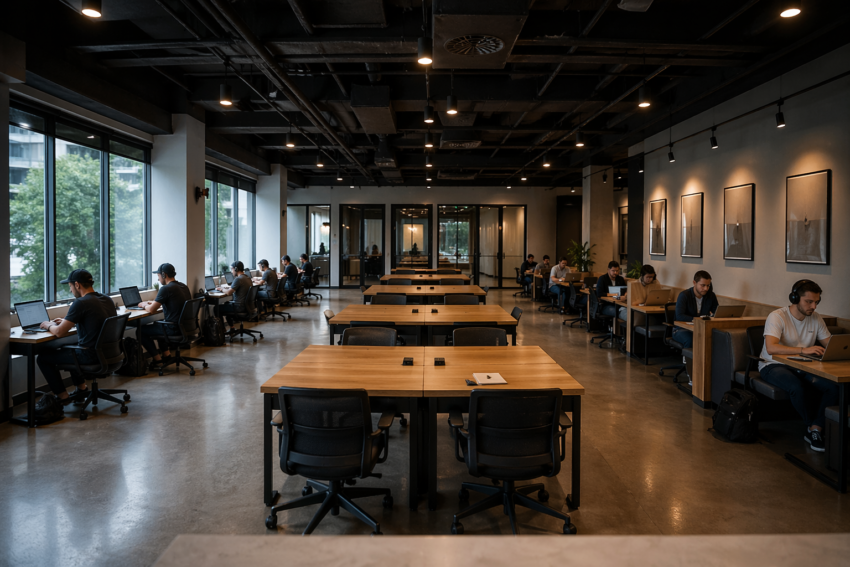
Walk into any coworking space at 9:30 a.m. and watch where people sit first. Not where the community manager hoped they would sit. Not where the promotional photos suggest they should sit. Watch where they actually sit.
The wall seats go first. The corners go first. The spots with a structural column behind them go first. Then the room fills slowly inward. The center desks stay stubbornly empty.
If your coworking floor fills from the perimeter inward, your center is not open. It is exposed.
What the Room Is Currently Saying
The operator arranged the central desks with the best of intentions. They wanted a bustling, collaborative energy. They bought beautiful furniture and maximized the square footage. The promotional photos show the center full of smiling members, leaning in over laptops, building the future together.
But openness is not the same as usability.
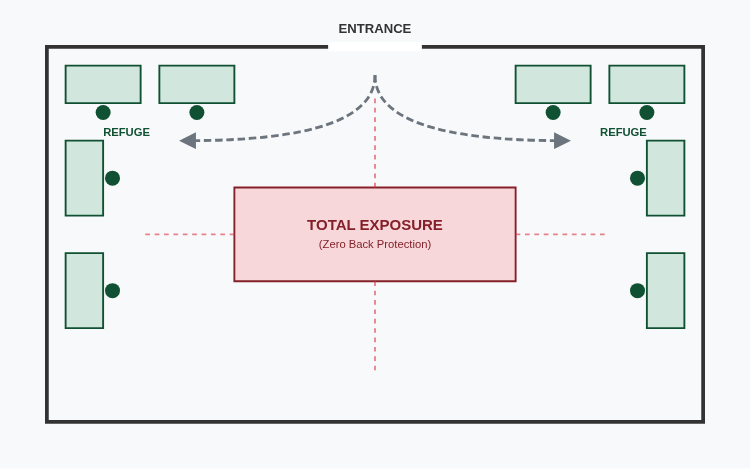
To the human nervous system, a massive field of unanchored desks says one thing: sit here and be watched from every direction. The room is not creating focus. It is creating defensive occupancy. Members are choosing biological safety over the designer’s intent, and the central square footage becomes a no-go zone that everyone is too polite to name.
The OED Read
This is a failure of Regulation and Optionality working together.
Jay Appleton’s prospect-refuge theory, foundational to environmental psychology, holds that humans naturally seek environments where they can see without being seen. The perimeter seats offer good refuge: walls, corners, and columns give the body a sense of cover. The center seats offer zero back protection. Every footstep behind a centrally seated member becomes part of their attention budget.
Lisa Feldman Barrett’s predictive processing framework explains what this costs. When the body cannot verify what is behind it, it spends metabolic energy continuously bracing for potential interruption. This is an autonomic tax. The member cannot direct that energy toward focused work, because the nervous system is already spending it on vigilance. The deeper the work the member is trying to do, the higher the tax becomes, and the more unbearable the central desk feels by the end of a long afternoon.
The Optionality failure compounds this. A well-designed coworking floor should offer a dial of exposure levels: fully private at one end, fully social at the other, with graduated options in between. The defensive-occupancy floor offers only two settings. Hide at the edge or perform in the center. There is no middle state, no honourable way to be partially visible, partially protected. That is not optionality. That is a forced binary, and the body chooses the edge every time.
The Business Implication
A coworking space does not sell desks. It sells a state of focused proximity.
Defensive occupancy is a silent revenue leak. When members consistently avoid the center, the operator has a false sense of capacity. The most visible square footage in the entire space is quietly unusable, which means the operator is paying rent on it twice: once to the landlord, and once in reduced member tolerance for the room as a whole.
Over time, members who cannot find a comfortable daily seat churn to a space that lets them breathe. They do not usually articulate why they left. They say the vibe was off, or the commute was easier elsewhere, or their schedule changed. What they are actually reporting is the cumulative cost of bracing against an exposed back for ninety days straight.
Lowering the autonomic cost of the central desks does not just increase utilization. It changes the kind of work members can do, which changes how they feel about the membership, which changes whether they renew.
The Fix
You do not need to build walls or lose capacity. You need to make the center feel anchored.
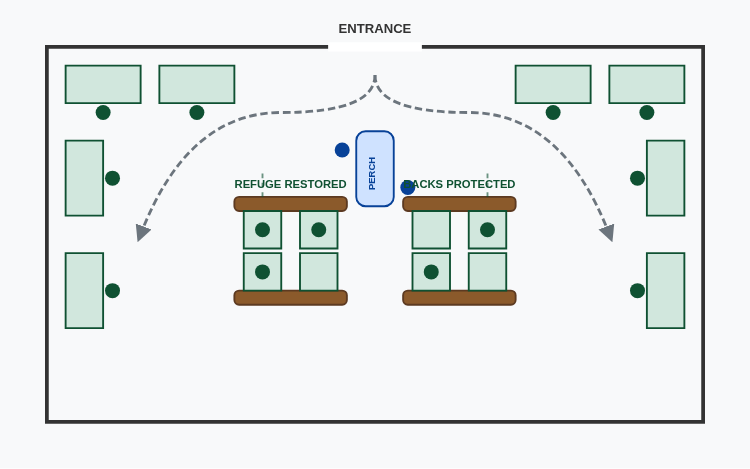
Zero-dollar fix. Reorient existing furniture so at least one central cluster has partial back protection. A row of desks facing the same direction, with the rear row backing onto a bookshelf or a wall element, converts the worst seats in the room into workable ones. Cost: one afternoon and a few willing hands.
Low-cost fix. Add low bookcases, heavy planters, or fabric-covered storage units behind central clusters. These function as visual anchors without closing off sightlines. Members sitting in front of them get the back protection their nervous system needs, and the room retains its open feel for the operator’s promotional photos. Cost: a few hundred dollars per cluster, most of which is furniture the operator can repurpose.
Moderate fix. Install half-height acoustic screens between central clusters. These serve double duty as back protection and as sound baffles, which addresses a second common coworking pain point (ambient noise) at the same time. Screens can be moved or reconfigured as membership patterns evolve. Cost: meaningful but one-time, and the ROI shows up in retention within a quarter.
Strategic fix. Redesign the center around a dedicated Third Object. A large shared plant arrangement, a coffee and tea station, a community library, a shared whiteboard wall. The Third Object anchors the room socially rather than just physically. Members orient toward it, which means their backs orient away from it, which means everyone in the room is facing a focal point rather than facing one another’s spines. The center becomes the most connective part of the space instead of the most exposed.
The Scene
A remote worker arrives on a Tuesday morning. For the first time in three weeks of membership, she does not head straight for the perimeter. A low bookshelf has appeared behind the central cluster, and the desk closest to it now has something behind it she can feel without having to check.
She sits down. She opens her laptop. She works for forty minutes before she realizes she has not once looked over her shoulder.
At some point she takes off her noise-canceling headphones. The founder of a small startup is at the desk across the aisle, and he asks her what she does. She tells him. He tells her what he is building. They talk for three minutes. She puts her headphones back on and returns to work, and she is more productive in the next hour than she was in the entire previous week.
That is what the room was supposed to be doing the whole time.
Your room is already telling people whether to stay or go. Most owners never hear it.
For $97, I’ll tell you exactly what it’s saying, why, and what to move to change the message. You get a full written diagnosis within a week. No renovation, no new furniture, no guesswork. Order now.