
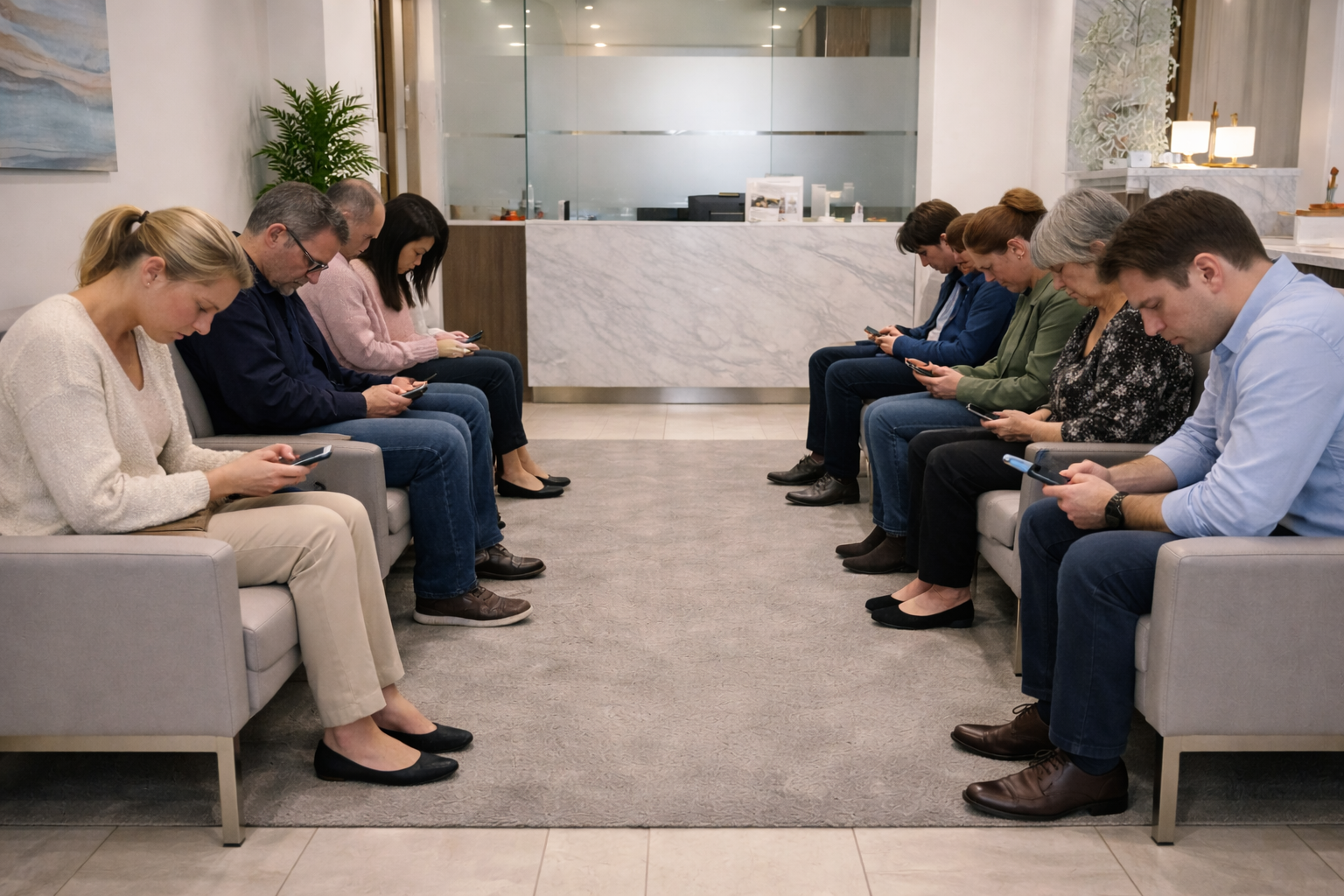
At first glance, this lobby looks fine. Expensive furniture, great natural light, and a clean aesthetic. But watch how people actually use it. Patients enter, sit down, hunch their shoulders, and bury their faces in their phones to avoid looking up. The practice owner arranged these chairs with the best of intentions. They wanted the room to feel open and symmetrical.
What the Room Is Currently Saying
Unknowingly, they have built an interrogation room. The chairs are pushed flush against the walls in rigid lines. Every seat directly faces the exact center of the room.
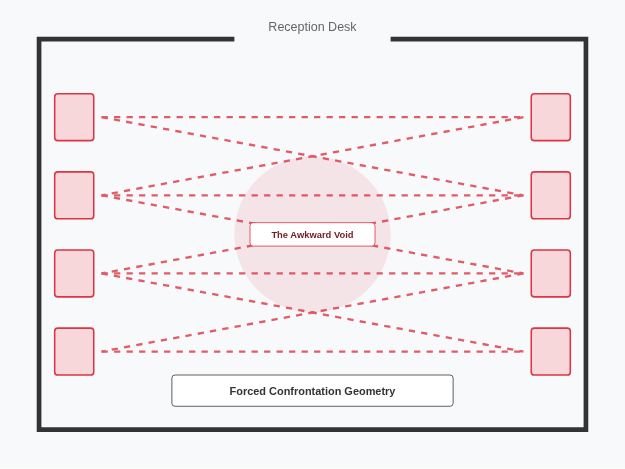
The spatial geometry is sending a highly aggressive signal. By lining the walls with inward-facing chairs, the room forces a face-to-face confrontation between strangers. You cannot look up without making direct, unbroken eye contact with the person sitting ten feet across from you. Everyone stares into the awkward void, and nobody crosses.
The OED Read
This is a failure of the Shared Attention lever. The geometry demands high-stakes interaction in a low-stakes environment. Optionality is absent. The room offers two choices: sit in the confrontation, or leave. No gradient, no hover zone, and no seat that offers partial retreat.
Jay Appleton’s prospect-refuge theory explains the mechanics. Humans need to see without being seen. Every seat in this room has its back exposed to the center. There is no refuge anywhere. The nervous system registers the exposure as threat.
Lisa Feldman Barrett’s predictive processing framework explains exactly why this exhausts your patients. The brain is constantly predicting its environment to budget energy. When a patient is forced into unavoidable eye contact with an unpredictable stranger, the nervous system registers ambiguity. It predicts a potential social threat. The body immediately starts spending metabolic resources on vigilance. Cortisol spikes. Anxiety blooms. All before they even hear the drill.
The Fix
You do not need an interior designer to fix this. You just need to break the confrontational sightlines.
- Pull the chairs away from the wall.
- Cluster them in small groups of two or three.
- Angle them 45 degrees toward a window, a painting, or a side table.
- Give the eye a safe place to rest that is not another human face.
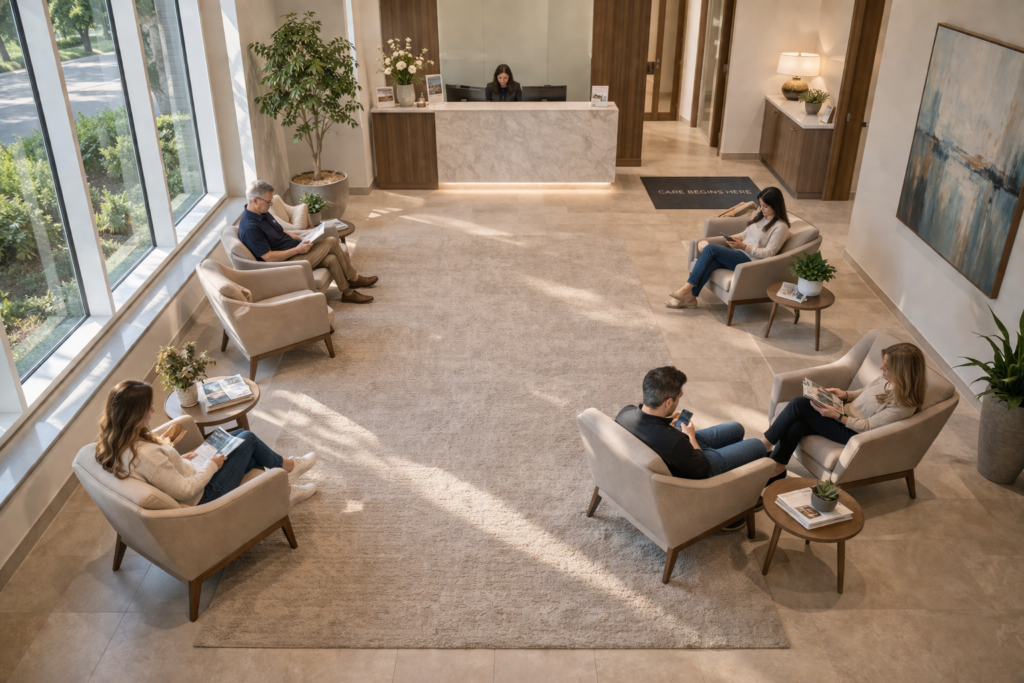
This provides a vital slice of refuge. It lowers the autonomic cost of waiting.
The Business Implication
A patient whose cortisol spiked in your waiting room is more likely to cancel their next appointment. That is a revenue leak with a spatial cause. When the nervous system feels secure, patient anxiety drops. Lower anxiety leads to easier procedures, fewer canceled follow-ups, and a drastically better reputation for your practice.
Most rooms do not need a renovation. They need a better invitation.
Your room is already telling people whether to stay or go. Most owners never hear it.
For $97, I’ll tell you exactly what it’s saying, why, and what to move to change the message. You get a full written diagnosis within a week. No renovation, no new furniture, no guesswork. Order now.