
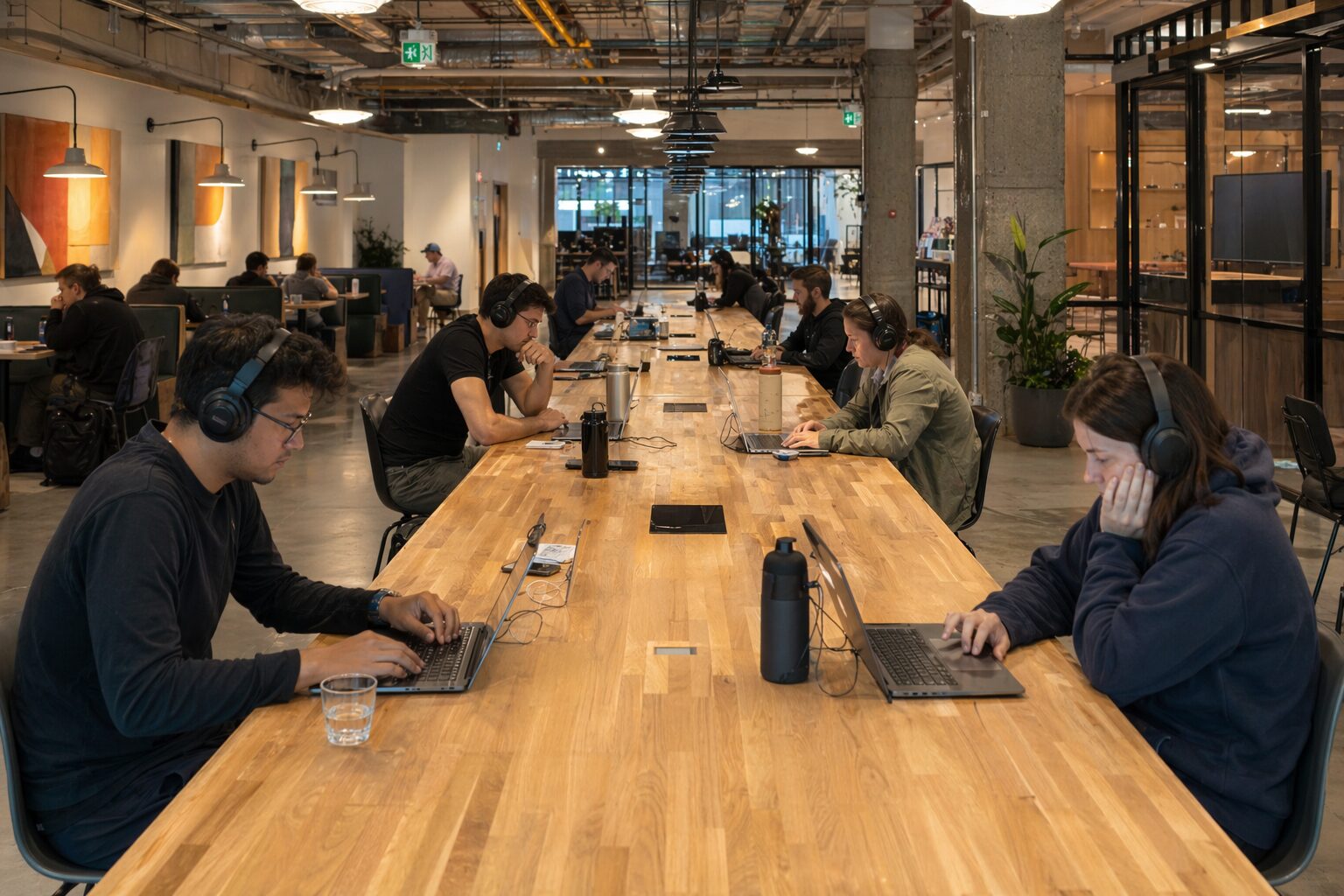
The marketing photos always feature the long oak table in the center of the room. It looks like the hub. The collaboration engine. The place operators imagine when they picture energy, collisions, and a membership worth renewing.
Then Tuesday morning happens.
Members take the corner booths first. Then the wall-facing perches. Then any seat with a little backing, a little cover, a little claim. The beautiful communal table stays empty until the room reaches capacity. And when people are finally forced to sit there, they do not relax into the openness. They put on noise-canceling headphones. They hunch their shoulders. They build a small fortress out of laptops, water bottles, and coffee cups.
The table was bought to bring people together. In practice, it broadcasts one message to every nervous system that walks in:
You are on display.
What the room is currently saying
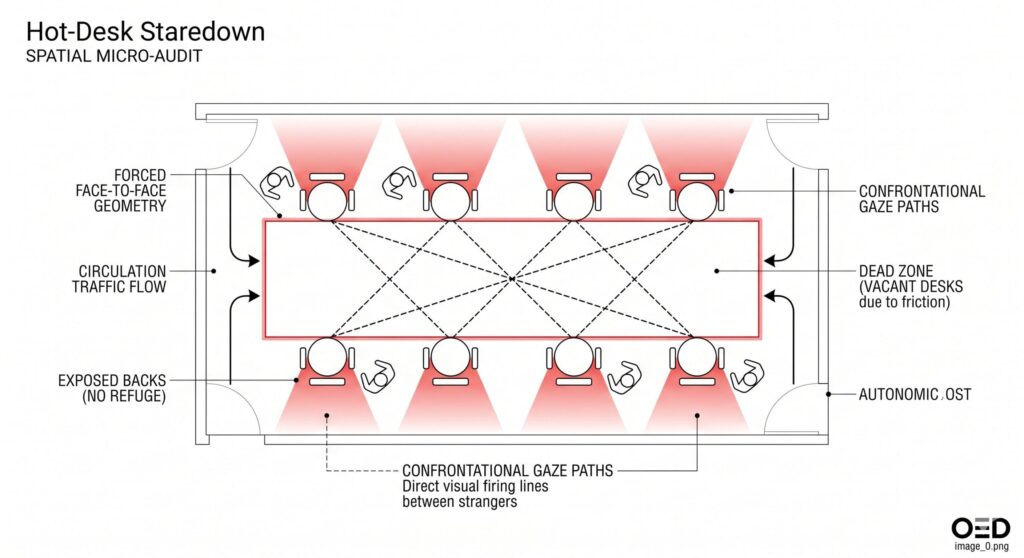
The geometry of a long communal table forces strangers into a direct, face-to-face firing line. It is a confrontational geometry dressed up as a collaborative one.
The room is telling the occupant: your back is exposed to the rest of the floor, and for the next four hours you must manage the gaze of the stranger sitting three feet across from you. Every time your eyes lift from the screen, they land on someone else’s face.
That is not collaboration. That is vigilance. And vigilance is expensive.
The OED Read
This is a simultaneous failure of Regulation and Shared Attention. Most rooms break one lever. This one breaks two in the same piece of furniture, which is why no amount of beautiful joinery rescues it.
Jay Appleton’s prospect-refuge theory is the spatial half of the diagnosis. Humans are wired to seek environments where we can see without being seen. Good prospect plus good refuge lowers cortisol. Floating backless chairs around a table in the middle of a busy floor destroys refuge. Forcing direct eye contact with a stranger three feet away destroys safe prospect. The occupant is stripped of both at once.
Lisa Feldman Barrett’s predictive processing framework is the nervous system half. The body is constantly running an energy budget based on environmental predictions. A room that signals “you are exposed from behind, and every time you look up you will meet a stranger’s eyes” gets read as a high-vigilance environment. The body responds by spending metabolic resources on monitoring instead of on deep work. That is the autonomic tax. Your members are paying it every minute they sit there.
So they do what every nervous system does when a room fails it. They build the refuge the designer forgot to build. Headphones amputate the audio channel. Hunched shoulders shrink the target. Laptop screens become visual shields. Every gesture is the body trying to manufacture refuge in a space that refuses to provide it.
Members are not avoiding the table. They are avoiding the geometry.
The Fix
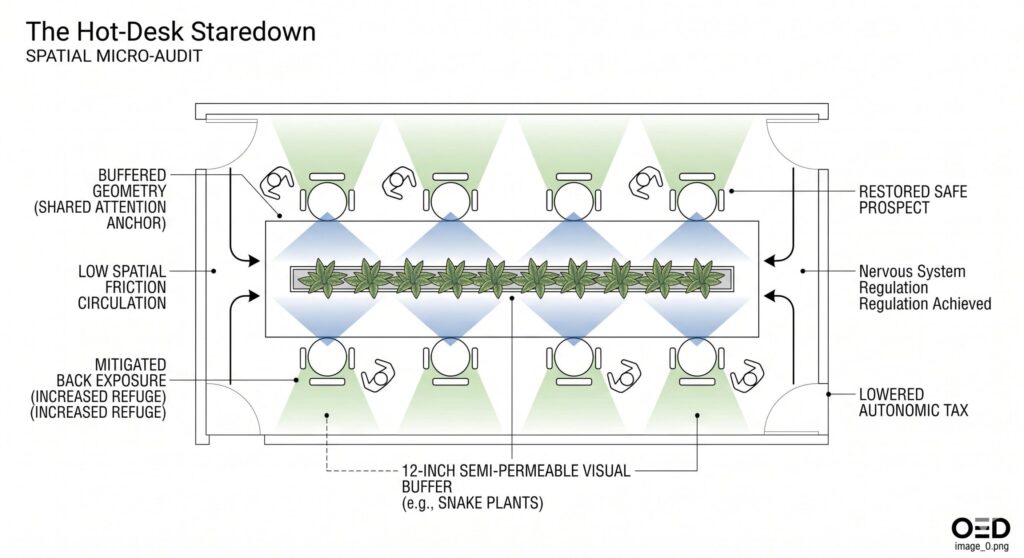
You do not need to buy new furniture. You need to stop the table from acting like a confrontation device.
Run a low, continuous, semi-permeable visual buffer down the center line. A 12-inch trough of snake plants works. A slatted wooden divider works. The point is not to wall people off. The point is to break the direct firing line so the nervous system gets permission to look up without making accidental eye contact.
The table stays open. It just stops being hostile.
Why this matters for business
Coworking operators do not make money from furniture. They make money from memberships that feel worth renewing.
When the main shared zone stays empty until the room hits capacity, the space is losing its single biggest competitive advantage against working from home: the accidental collision. Members are present but not attaching. They are using the building without entering the social life of it. And every month a member uses the building without feeling the social life of it is a month closer to cancellation.
The Staredown turns your flagship zone into a silent churn engine. Fixing it is one of the highest-leverage moves in the building, and it costs less than a month of one member’s dues.
Where else the Staredown shows up
The Hot-Desk Staredown is the coworking expression of a broader archetype: a shared surface whose geometry forces strangers into sustained, unbuffered eye contact. Once you can see it in one room, you cannot un-see it in the others.
The hotel lobby communal table. The long live-edge slab in the center of the boutique lobby. Solo travelers walk past it, check in, and take their laptop to their room instead. The lobby photographs beautifully and earns nothing.
The restaurant shared counter. The communal dining bench in the fast-casual concept. First pairs of diners pick the ends. The middle fills only when the ends are full. Turnover suffers because nobody settles in.
The airport gate. Rows of seats facing each other across a walkway. Every traveler becomes a stranger’s television for ninety minutes. Posture is defensive, charging ports go unused, and the gate area feels louder than it actually is.
The therapy waiting room. Chairs arranged in a square facing inward. The patient who arrived already at low capacity spends fifteen pre-session minutes managing eye contact with other patients. The session starts at a deficit the clinician then has to dig out of.
Same geometry. Same nervous system response. Same quiet revenue leak.
The civic stakes
Loneliness is now classified as a public health crisis on par with smoking. The U.S. Surgeon General has said so explicitly. Coworking is one of the few categories of room where adults can be near other adults, daily, without having to perform a role or buy a drink to justify being there. Which makes the open work zone a piece of leveraged real estate for moving the loneliness needle.
And we keep filling it with furniture that quietly drives people to the phone booths.
An operator who fixes the geometry of their shared table is not just raising dwell time and renewal rates. They are running a small, daily public health intervention. They are producing belonging that renews itself, in a country that is starving for it.
The Scene
A freelance designer opens her laptop at the communal table. The plant line down the middle breaks the stare path just enough. She can work in the open without feeling sealed into a social interrogation.
Across from her, a developer looks up. Their eye contact is brief, easy, unforced.
Ninety seconds later, one of them asks a quick question about a client problem. The conversation lasts two minutes. She walks back to the table the next morning instead of staying home.
Nobody designed that moment. The geometry did.
Most rooms do not need a renovation. They need a better invitation.
Your room is already telling people whether to stay or go. Most owners never hear it.
For $97, I’ll tell you exactly what it’s saying, why, and what to move to change the message. You get a full written diagnosis within a week. No renovation, no new furniture, no guesswork. Order now.