
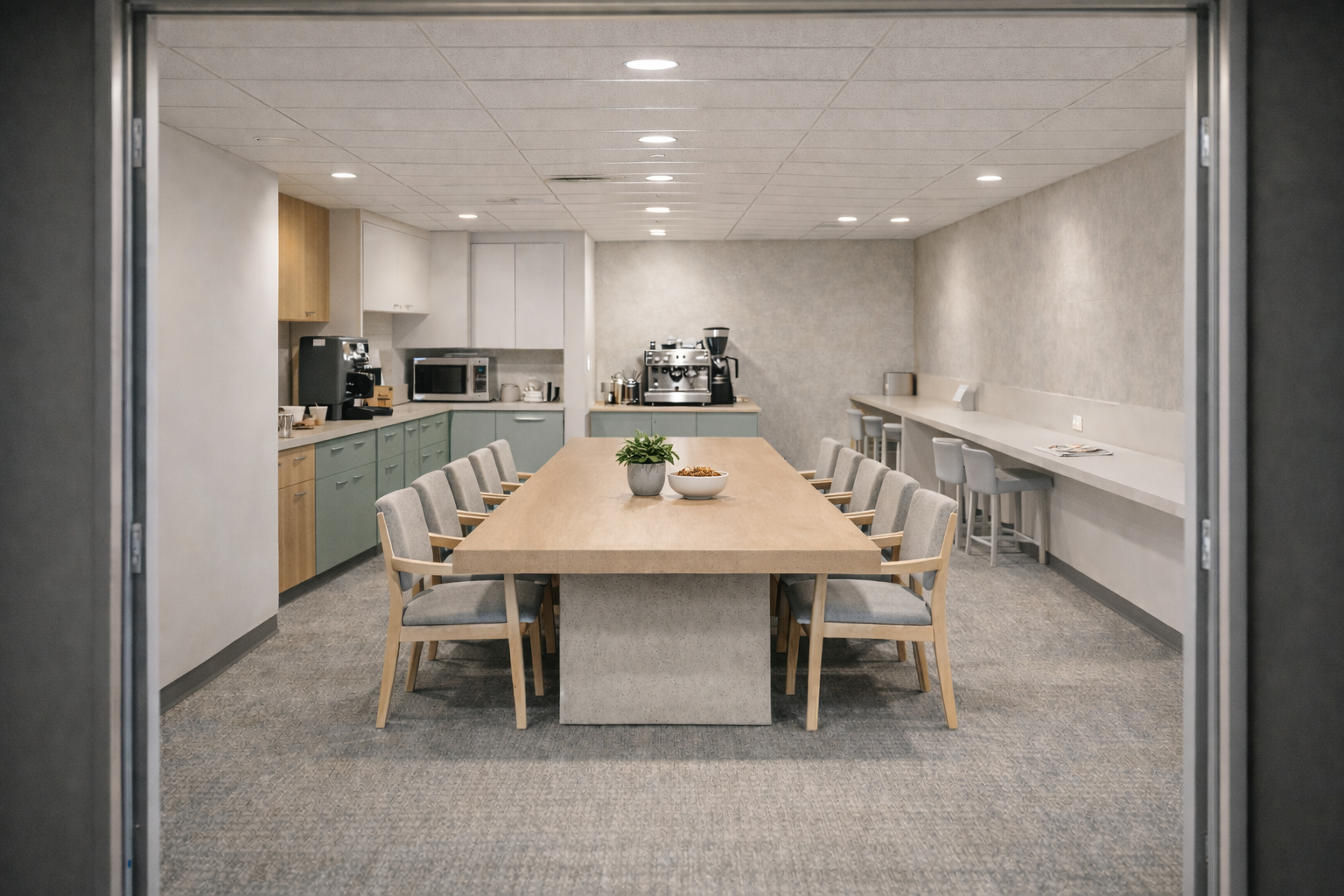
At first glance, this corporate break room looks flawless. The company invested in a high-end espresso machine. They bought beautiful mid-century modern chairs. The lighting is warm. But watch how people actually use the space. Employees rush in, grab their drink, and flee back to their desks. The beautiful seating stays perfectly arranged and completely empty.
This pattern shows up in nearly every corporate break room I walk into. I call it the Dead End. The geometry differs in each office, but the result is always the same: a room designed for gathering that actively repels it, and a facilities team that blames culture for what is actually a spatial design problem.
What the Room Is Currently Saying
The room is set up as a physical cul-de-sac. The doorway is narrow. The coffee station sits at the deepest point of the room. A large communal table blocks the center. This geometry is not inviting people to gather. It is telling them that entering this space is a high-stakes decision.
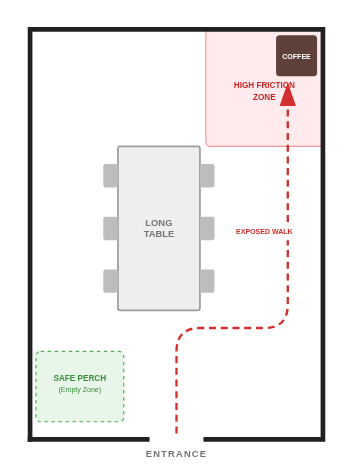
To get a coffee, an employee must walk the full length of the room, past the long table, into the back corner. If someone is already there, the employee is trapped deep in a space with a single narrow exit. The social cost of escaping is enormous. So the brain does the math before the body commits. Most people grab the fastest possible drink and leave.
The room forces a binary choice. You are either all the way in, committed to whatever social situation unfolds. Or you are out. No middle ground.
The OED Read
This is an Optionality failure. Two things are broken at once.
The Commitment Geometry. The coffee station sits at the deepest, most socially expensive point of the room. Jay Appleton’s prospect-refuge theory explains why this matters biologically. Humans carry a non-negotiable need to evaluate a space before committing to it. The employee approaching that narrow door cannot survey the room, cannot protect their back, and cannot exit quickly. Zero refuge, maximum exposure. The architecture is a trap.
The Gradient Gap. There is no perch, no hover zone, no partial retreat. Lisa Feldman Barrett’s predictive processing framework describes what happens next. The body constantly budgets energy based on environmental predictions. When an employee calculates the cost of entering this room, the nervous system registers the missing gradient as ambiguity. It predicts a social obligation it cannot easily escape. The body starts spending metabolic resources on vigilance before the employee even crosses the threshold. The decision to flee is already made. The room is physically available but socially expensive.
The Fix
Do not rip out the cabinets or buy new furniture. Most rooms do not need a renovation. They need a better invitation.
Move the primary coffee machine out of the deep corner and place it closer to the entrance. Then add a standing-height perch, a narrow counter or a high-top, right near the doorway. This gives people a place to pause. They can lean, take a sip, and survey the room without fully committing to sitting down. The perch creates the missing gradient: a low-stakes position between the hallway and the big table, where the cost of entering is nearly zero and the cost of leaving is nothing at all.
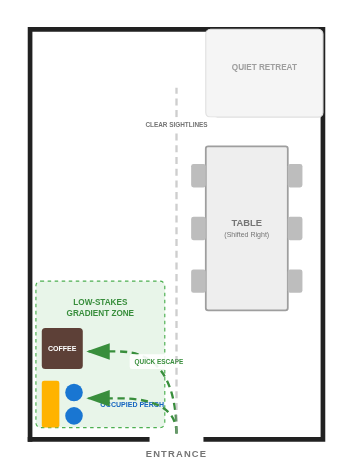
The directional principle: this space needs a gradient of commitment between the door and the deep end of the room. That is the hint. The full assessment of where to place every element and how to build a true convergence zone is what a complete OED consultation delivers.
The Business Implication
Companies spend millions trying to force cross-departmental collaboration. They schedule mandatory mixers and build massive open-plan desks. But true innovation lives in low-stakes, accidental collisions. When a break room spikes cortisol, those collisions never happen. Fixing the spatial friction of getting a coffee instantly increases the frequency of spontaneous interactions. You break down silos simply by changing where people stand.
The Scene
A data analyst stops at the new perch by the door to stir her coffee. Back to the wall, she is partially facing the hallway. A marketing director passes by and pauses. Because neither of them is trapped in a corner, the stakes are perfectly low. They chat for ninety seconds, solve a communication bottleneck, and part ways easily.
Most rooms do not need a renovation. They need a better invitation.
Your room is already telling people whether to stay or go. Most owners never hear it.
For $97, I’ll tell you exactly what it’s saying, why, and what to move to change the message. You get a full written diagnosis within a week. No renovation, no new furniture, no guesswork. Order now.