
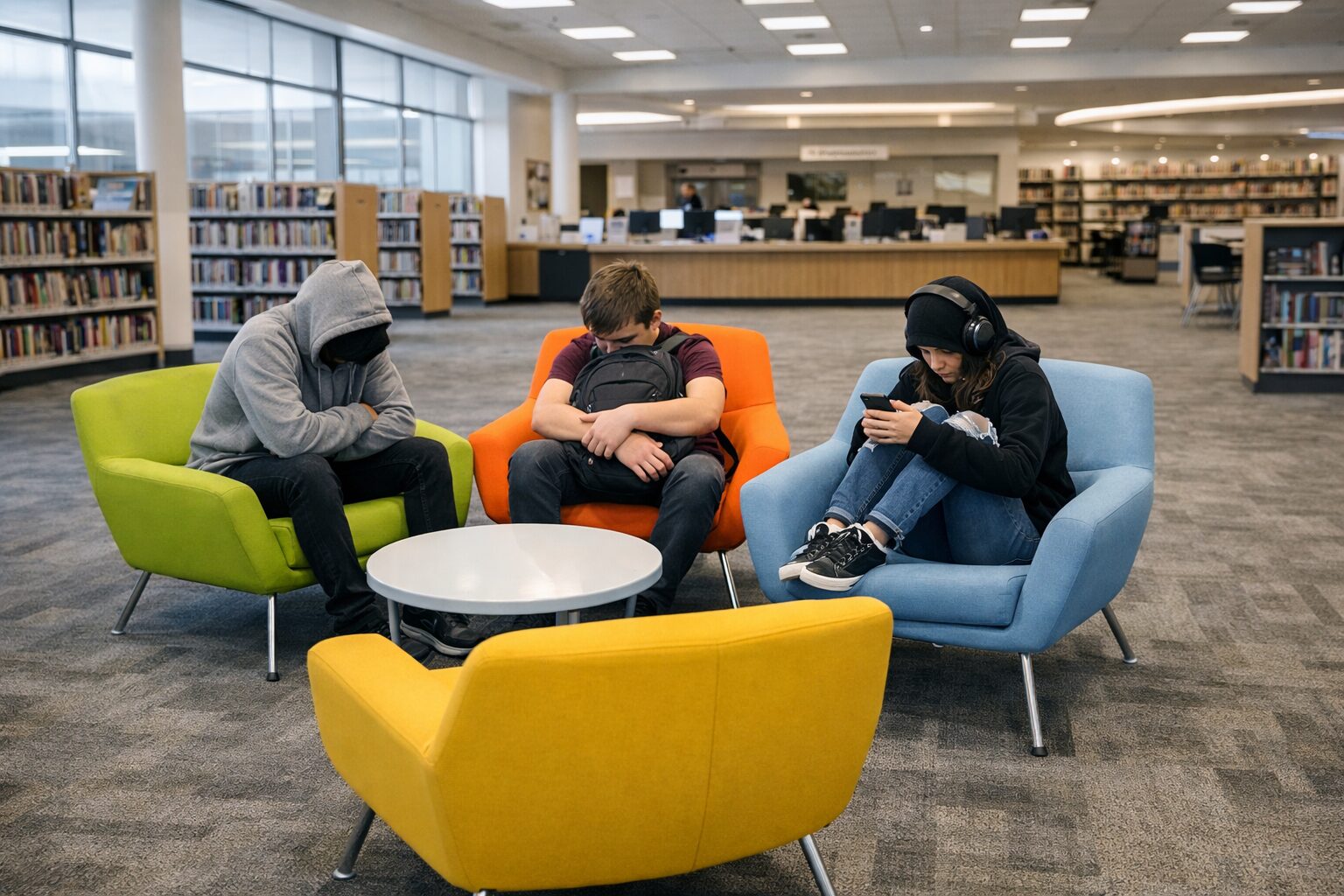
The new youth corner looks like a massive win. Bright furniture. Integrated charging ports. Clear sightlines straight from the circulation desk. So why are the teenagers sitting in the fire stairs?
Walk into almost any newly renovated public library and you will find the same thing. A few thousand dollars of cheerful modular seating placed in the visual center of the floor plan. Phone-charging hubs. Maybe a sensory-friendly nook. The librarians are proud of it. The architect won an award for it. And the teenagers, the people the room was actually built for, are nowhere near it.
They are clustered in the fire stairs. They are tucked behind the oldest book stacks. They are sitting in the brand new bean bags with their hoodies pulled tight and their bodies curled inward, building the walls the architect forgot to build.
What the room is currently saying
The room is saying: we built this for you, but we don’t trust you.
It is a stage, not a sanctuary. Every chair faces outward into the open floor. The table sits in the dead center of the most surveilled zone in the building. The circulation desk has unobstructed sightlines straight through the cluster. The staff can see every face. The other patrons can see every face. The traffic flow from the entrance funnels right past it.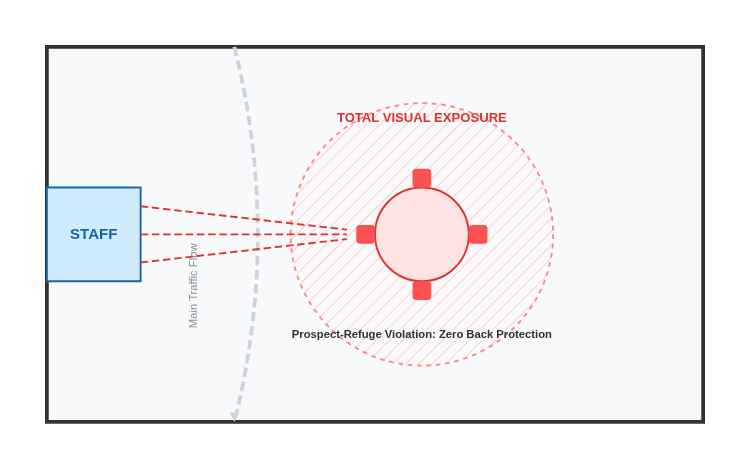
The space offers two settings: full exposure or leave the building. There is no perch, no semi-private corner, no back-to-wall option, no place to hover before committing. You either sit on the stage, or you go.
The OED Read
This room is failing on two of the three OED levers at once. Most rooms fail on one. This one fails on two, simultaneously, in the same eight square meters. That is why no amount of bright upholstery saves it.
Regulation is broken. The teenager has no way to control how exposed they are. Every chair faces outward. Every body in the room can see every face. There is no dimmer switch on the visibility.
Optionality is broken. The space offers two settings: full exposure or leave the building. No perch. No semi-private nook. No back-to-wall option. No way to hover before committing. The gradient between social and solo, between visible and hidden, has been amputated.
Jay Appleton’s prospect-refuge theory is the spatial half of the explanation. Humans, and developing nervous systems especially, are wired to seek environments where we can see without being seen. Good prospect plus good refuge lowers cortisol. Violations spike it. Appleton was writing about landscape painting in 1975, but his framework applies to any room a human body has to sit in. The teen zone in question is one hundred percent prospect and zero percent refuge. It is, biologically, a savanna with no thicket.
Lisa Feldman Barrett’s predictive processing framework is the nervous system half. The body is constantly running an energy budget based on environmental predictions. A room that signals “you are visible from every angle, you do not control who is watching, and the staff has unobstructed sightlines” reads as a high-vigilance environment. The body responds by spending metabolic resources on monitoring instead of on connection, on play, on homework, on becoming. That is the autonomic tax. The teenagers are paying it the moment they walk in.
So the teenagers do what every nervous system does when a room fails it. They build the walls the architect forgot to build. They use backpacks as visual shields. They put on noise-canceling headphones to amputate the audio channel. They pull their hoods up to limit peripheral vision. They turn their bodies inward toward each other, away from the room. Every gesture is the body trying to manufacture refuge in a space that refuses to provide it.
The teenagers are not avoiding the library. They are avoiding the geometry.
The Fix
You do not need to tear out the zone. You do not need to blindfold the librarians. You do not need to file a capital request. You need to restore a basic biological baseline, and you can do it this afternoon with what is already in the building.
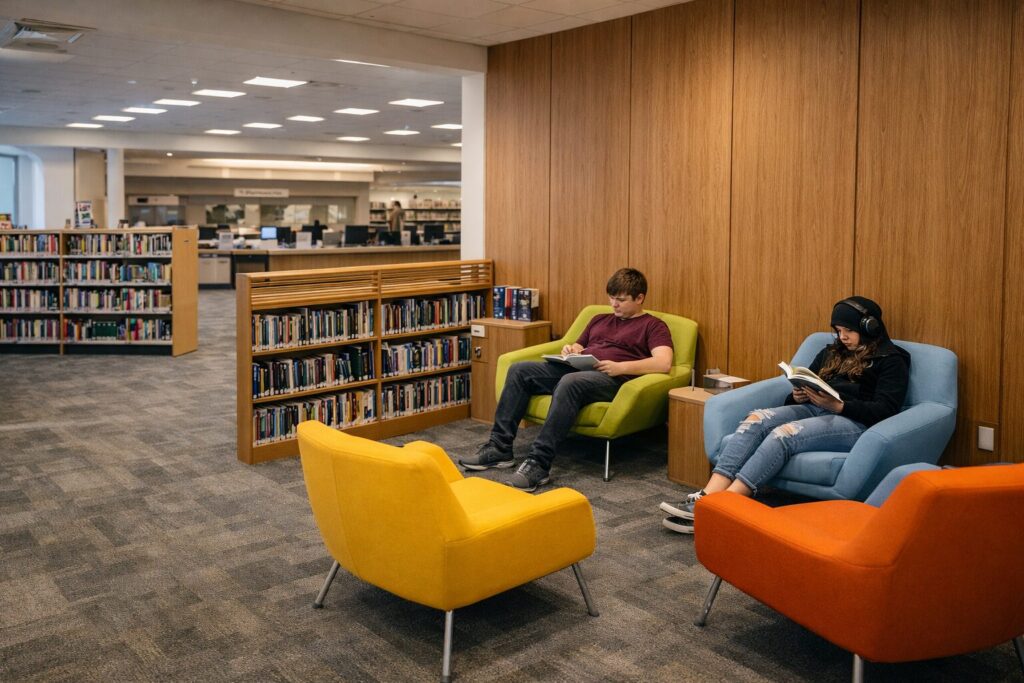
Pull the seating cluster out of the dead center and anchor it against a solid wall. That single move solves the prospect-refuge violation: backs are now protected, eyes are now free to scan the room without being scanned in return. Then, introduce a semi-permeable visual buffer between the cluster and the circulation desk. A low bookshelf works perfectly. So does a slatted wooden screen, or a row of tall plants. The staff can still see feet and the tops of heads, which is what staff actually need for safety. The teenagers feel hidden, which is what they need to settle.
Add one perch along the buffer for the kid who wants to be near the cluster but not inside it. That perch is the gradient. That is what completes the Optionality fix.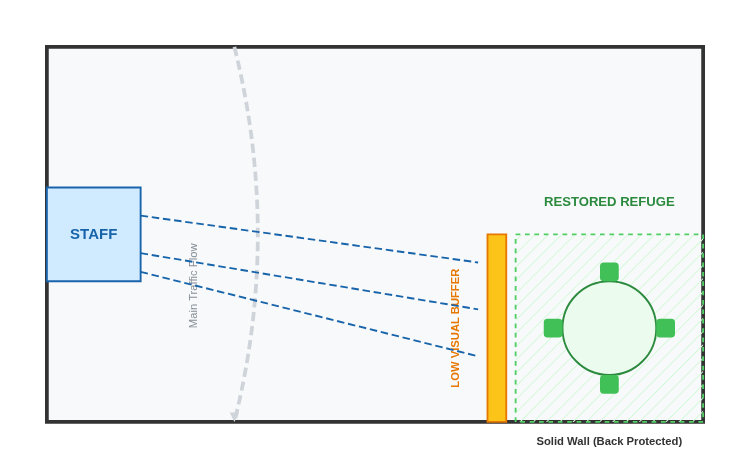
The Civic Implication
Loneliness is now classified as a public health crisis on par with smoking. The U.S. Surgeon General has said so explicitly. Civic spaces, libraries especially, are one of the last categories of room a person can enter without having to buy something, perform something, or justify their presence. Which means civic spaces are some of the most leveraged real estate we have for moving the loneliness needle.
And we keep building them in ways that quietly drive people out.
A teenager whose nervous system reads “unsafe” the moment they enter a library is a teenager who learns, slowly and without ever consciously deciding, that civic space is not for them. They become an adult who does not vote on library bonds. An adult who does not bring their own kids back. An adult who does not see “the library” as a place where loneliness gets shorter.
Fix the geometry of refuge and you lower the autonomic load on every body in the room. Vandalism complaints fall. Noise complaints fall. Engagement metrics rise. But the real return is harder to put on a budget line: you raise the next generation of patrons who feel, in their bones, that the building is on their side.
The Scene
A teenager drops a heavy backpack onto the floor next to the chair. They sink into the corner seat with the solid wall behind them. They pull the headphones down around their neck without thinking about it. They open a notebook. Forty seconds later, their shoulders are no longer up around their ears.
Nobody designed that moment. The geometry did.
Most rooms do not need a renovation. They need a better invitation.
Where Else the Teen Aquarium Shows Up
The Teen Aquarium is the youth-library expression of a broader spatial archetype: a transparent or fully-exposed enclosure designed for the convenience of the watcher rather than the comfort of the watched. The same geometry, and the same nervous system response, recurs across verticals. Once you can see it in one room, you cannot un-see it in the others.
The glass phone booth. The “private” call room in the open-plan office, walled in glass, placed in the bullpen’s sightline. People walk in to make a phone call and walk out without making it.
The collaboration zone. The open-plan classroom’s “flexible learning space,” a cluster of brightly colored seating arranged in the most surveilled corner of the room. The students who use it are the students performing for the teacher.
The memory care commons. The central lounge in a memory care unit, designed for staff sightlines. Residents migrate to the perimeter and to the rooms they were told to leave.
The therapy waiting room. Chairs facing the receptionist, exposed from the hallway. The patient who is already at low capacity arrives at the appointment with their nervous system already taxed.
Your room is already telling people whether to stay or go. Most owners never hear it.
For $97, I’ll tell you exactly what it’s saying, why, and what to move to change the message. You get a full written diagnosis within a week. No renovation, no new furniture, no guesswork. Order now.